Archives: 2012

An Announcement

I’m very happy to announce that I recently agreed to sign a contract with Berkley Publishing Group in the US for publication of the Raven’s Shadow trilogy. Berkley is a US imprint of Penguin Books which includes the Ace and Roc Sci-Fi/Fantasy lines, so it will be an honour to have my work appear on the same imprint as Stephen Donaldson, Joe Haldeman, Ursula LeGuin and William Gibson (among many others).

It will take some time for the print edition of Blood-Song to appear so rest assured the current ebook version will remain available, at the same price, probably into 2013.

I’m aware of the ongoing debate about traditional versus indie publishing and fully appreciate why some authors have chosen to stick with the independent route. However, having thought about it long and hard, I decided this was the best choice for me. If I’m ever going to get to the point where I can start writing full time I need my work to reach a wider audience, including foreign language markets and bookstores, neither of which are open to me at present.

Many readers will no doubt be wondering what this means for Tower Lord. The fact is, at this stage I just don’t know. I still intend to finish it this year, but giving any indication as to a publication date would be pure speculation at this point. I’ll post any news here in due course.

Now, off to celebrate with a marathon session on Sniper Elite V2 (buy it, it’s really good).


Tower Lord Milestone #3

Passed 100,000 words of the first draft today. I must admit my daily word-count of late has not been as high as I would like, but I am writing every day and remain happy with the quality and the way the story is shaping up. And, in anticipation of an oft-asked question, no I don’t have a release date yet.

As Chuck Heston once told Pope Rex Harrison in answer to the question: “When will you make an end?” – “When I’m done.”

(And I’m not saying my work is on a par with the Sistene Chapel or anything… that’s for other people to say.)


The Secret to E-book Self-Publishing Success

As it’s been about five months since I published Blood Song in which time I’ve sold over 2000 books (admittedly most of them this month). So I thought it might be time to reveal the secret of self-publishing an e-book that sells. Don’t waste your time and money on how-to books or webinars, for I have the answer right here for free. Ready? OK, here goes:

Write a good book.

That’s it. There’s no mystery, no short-cuts and no substitute. If you want to write a book that sells, make it a good one. The advent of e-books has certainly opened the flood-gates to an enormous amount of unreadable dross, but it’s also brought about a new meritocracy in publishing. Put simply, if it’s good it will sell. If it’s not, it won’t and no amount of publicity will magically turn it into the bestseller you want it to be.

If you’re going to do this thing, accept the fact that you exist in a meritocracy, a real one. Not the pretend meritocracies of the corporate world where success is largely a matter of fooling gullible management into believing how great you are (read Jon Ronson’s The Psychopath Test if you don’t believe me). In a real meritocracy all that matters is ability. Not popularity, not inter-personal skills, not a facility for spewing jargon and buzz-words. Just being good at what you do, and being good at something requires work.

Writing is hard and it takes a long time to do it well. I estimate it took me about 100,000 words before I got to a point where I wasn’t embarrassed to show people my work, and another 100,000 before I felt confident enough to publish it. So if you want to do this, get writing. Write every day, whenever you can. And, if you’ve never written before, accept the fact that you’ll probably write crap for the first 100,000 words or more. But having written 100,000 words you will definitely be a better writer than when you started. Writing is a craft and you can learn it, but learning requires doing, and no one is going to do it for you.

Worry about the mechanics of publishing when you’ve written something worth publishing. As you can learn to write you can learn to format a word file correctly, you can learn the basics of graphic design to produce your own covers, you can learn to write a blurb, you can learn to set up a blog or a website. But do it after you’ve actually written a book that’s worth someone’s time and money. And most of all, be honest with yourself. Deep down, you will know if the book you’ve written is ready for publication. Listen to that voice and don’t publish before you’re ready. Canvas second opinions from people you know will give you an honest critique and listen to what they tell you. If it’s not ready, don’t publish it. I’m eternally grateful for the fact that e-books came along after I’d gotten most of the dross out of my system, otherwise I might well have been tempted to publish it, with potentially ruinous results. Most pro-writers will have an anecdote about the terrible novel they stupidly sent out to publishers and subsequently burned so no one else would ever see it. You may have spent years on a novel only to find it’s just not very good – I did, more than once. Does that mean all that time was wasted? No, because I learned from it, I got better.

As writers we exist in a true meritocracy now. Publication is now open to all, but success is dependent on ability. It’s just about writing good books.


An Odd Moment

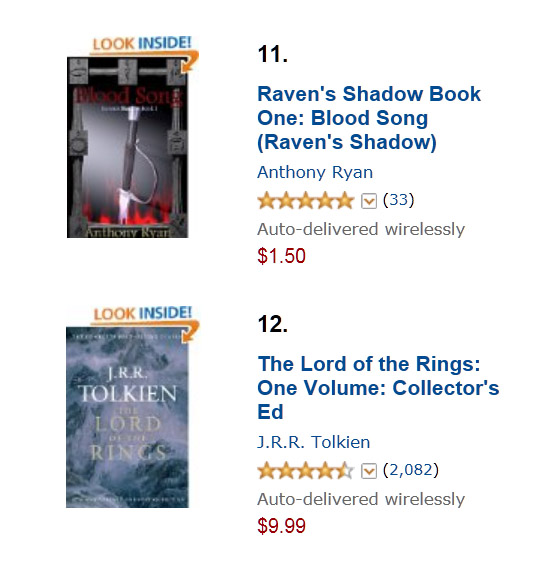
A notveryhumblebrag, and a singularly odd moment when I checked my rankings today:

Maybe I’m dreaming.

PS. re. the growing number of queries about Tower Lord – please rest assured I’m working on it (and looking forward to the day when finally I can sleep).


Writing News – Tower Lord Milestone #2

The 9 chapters comprising Part I of Tower Lord are now complete in the first draft. Total word count now stands at 59,000+. The daily total has slowed somewhat due to a stinking cold, but I am working through it. Watch this space for further updates.


Writing news – Tower Lord Milestone #1

Completed my fifth Tower Lord chapter yesterday, which takes the first draft up to 30,000 words plus which is roughly equivalent to 100+ hardcover pages. Only about another 200,000 words to go. Still managing the 2000 word a day target despite some recent personal troubles. Updates to follow on future milestone passing as and when…


Best writing advice ever…

If you’re interested in getting involved in this whole writing / publishing lark then the Writing Excuses podcast this week contains the best advice ever for aspiring writers:

http://www.writingexcuses.com/

Work on Tower Lord continues apace, still managing over 2,000 words a day which must be some kind of record for me. I’ll post another update when the word count reaches 100,000.


A History of Television Space Opera Part 4: Battlestar Reborn – the Last Hurrah of Television Space Opera?

The reborn Battlestar Galactica (USA, 2003-2009) was conceived by co-creator and show runner Ronald D. Moore as a deliberate “reinvention” of space opera, an ambitious, some might say arrogant, aim. However, over the course of a three hour miniseries and four full seasons, the series more than justified the claim.

The basic premise remained largely unchanged from Glen A. Larsson’s mormon inspired original. In a distant corner of the galaxy a race of space-faring humans has colonised twelve worlds and nearly engineered its own destruction by creating a race of self-aware robots, the Cylons. After a costly war an uneasy truce has reigned between human and Cylon, until they develop the ability to look like humans, whereupon things get very bad very quickly. With the twelve colonies destroyed in a Cylon sneak attack, the remnants of humanity escape to the stars in a ragtag fleet, protected by the one surviving Colonial warship Battlestar Galactica, seeking a new home on the fabled thirteenth colony known as Earth. To this Moore and series producer David Eick (not that one) added a modern, hard-edged sensibility, playing everything absolutely straight with no whiff of cheese, enlivened by a real eye for action and intrigue. This provided a solid basis for stories on a range of themes, from tension between military and civilian authority in a time of crisis to racial prejudice and the fine line between terrorist and freedom fighter. This unapologetically allegorical approach made it very much a product of the post-911 era, a theme enhanced by the revelation in the first season that the supposedly cold and logical Cylons are in fact monotheistic religious fanatics. The Colonial humans, with all their allusions to Greek mythology, are polytheists. This is religious conflict through the lens of space opera.

Battlestar’s thematic depth was matched by its commitment to characterisation, the two authority figures of Commander William Adama and President Laura Roslin were a compelling presence at the heart of the series, their initial antipathy changing over time to deep affection. Alongside this was added a myriad of interlinked story arcs too complex to unravel at length, but the journey towards redemption experienced by ill-disciplined screw-up Kara Starbuck and guilt-ridden and (literally) haunted traitor Gaius Baltar, are perhaps the most compelling and complete examples of character development offered by recent television, matched only by the journey of Jimmy McNulty in The Wire.

Like all good stories, Battlestar Galactica had an ending, much derided though it turned out to be. In company with fantasy series Lost, Battlestar’s ending suffered from an excess of expectation. No conclusion, no matter how spectacular, surprising or cleverly plotted, was ever going to match the heights of anticipation reached by series devotees. And personally, I liked it – shoot me (wasn’t even that bothered by the ending of Lost, knew they guys had just been making it all up as they went along for years).

Battlestar Galactica spawned spin-off prequel series Caprica which sadly lasted only one season and doesn’t really fall into the category of space opera. That torch was passed to Stargate Universe which I’ve yet to see, but got cancelled last year anyway. The producers of Battlestar Galactica have recently announced plans for another prequel spin-off in the form of Blood and Chrome which will relate the adventures of young fighter pilot William Adama in the first Cylon war. Whatever the merits of the central idea (we already know how it ends so what’s the point?) we should at least get to see some cool space battles. If it survives the pilot stage, television space opera may have a future, if not, it was a wild ride.

The vision of our space-based future began brightly then darkened as the optimism of the 1960s faded and old certainties were undermined by the end of the cold war and the coming of the war on terror post 9/11. The pessimism of later space operas, and its recent decline as a television genre, can be partly explained by the advance in technology since the first broadcast of Star Trek, heralding undeniably great changes, but also a distinct lack of either global progress or regression for our species. Although warp drives, teleporters and photon torpedoes continue to elude us, modern innovations like mobile telephones, lasers and CAT scanners seem equivalent to the personal communicators, phasers and tricorders employed by Kirk and crew. In an age when technology has seemingly caught up with much of the future promised by space opera in its various forms, audiences may find it hard to accept that technological progress equates to either utopian prosperity or dystopian nightmare. Things change, people stay the same. If the future is now, it’s clearly far from peaceful nor, for much of the world, prosperous. On the other hand, most of us don’t live in a dystopian struggle for daily survival either. There seems little reason to assume the future, even with ever-advancing technology, will be any different. When the self-aware robots turn up though, it may be time to worry.


And so it begins…

Started Tower Lord today, a week earlier than intended but the muse was with me. Two thousand words a day target was exceeded and it’s all flowing nicely. Having said that, give me a week and I’ll probably decide I hate it and start over. For the moment though, it’s going well. Scarily, if it all goes according to plan this one will be even longer than Blood Song. Updates will be posted on an occasional basis. Any downtime will be spent recording the podcast version of A Hymn to Gods Long Dead (plus rewarding myself with the odd episode of Community, which is every bit as good as I heard it was).


A History of Television Space Opera, Part 3: Firefly – The End of Utopia

Whilst the final Trek series was still on air the Fox Network commissioned the most dystopian space opera to date: Firefly (USA 2002), created by Joss Whedon, one of a growing number of show-runners who can reasonably claim the title of ‘autuer’, having produced the hugely successful Buffy the Vampire Slayer (USA 1997-2001) and spin-off Angel (USA 1999-2004). Firefly was one of several shows commissioned and then cancelled mid-run by Fox in a sustained bid to find a replacement for the massively successful The X-Files (USA 1993-2002) in the 8pm Friday night slot. Other genre shows Harsh Realm, Brimstone and John Doe had all fallen foul of cancellation in quick succession as Fox executives tried to recapture the elusive formula that made The X-Files such a success.

Like Star Trek, Firefly was conceived as a space western, but whilst the western influence on the adventures of Kirk and co. is vague at best, Firefly’s inspiration is obvious from its credit sequence where the Serenity is shown swooping low over a stampeding herd of mustangs. Stories consistently feature such western conventions as six-shooters, bounty hunters and cattle rustling and characters speak a mixture of colloquial frontier English peppered with Mandarin obscenities.

The basic elements of the series were set out in the pilot Serenity. Five hundred years in the future, mankind has migrated to a new solar system, terraforming its many moons and leaving Earth behind, referred to as ‘Earth that was’. This society is split between the prosperous and technologically advanced ‘core planets’ and the poverty stricken, crime ridden ‘outer worlds’ where freelance Captain Mal Reynolds (Castle star Nathan Fillion) commands the aged Firefly-class freighter Serenity. The western theme continues in the form of the Reavers, a cannibalistic Comanche like race of “men gone mad on the fringes of space” who prey on vulnerable ships. This is a society where life is cheap and criminality a necessary part of daily survival, summed up by series writer Jane Espenson as “a world where no obvious rewards await the virtuous.”

Series pilot Serenity is a two hour space-based chase thriller where Mal and crew discover two fugitives in their midst: Simon and River Tam. Simon, a doctor, has rescued his sister River, an apparently mad teenager with a genius IQ, from a mysterious Alliance institution where she has been subject to damaging medical experiments. The crew successfully elude both Reavers and Alliance agents, Mal allowing Simon and River to stay as the ship is in dire need of a doctor; at least one member of the crew is shot or stabbed in every episode.

Although the Fox network rejected Serenity on the grounds that “they wanted the captain to be more accessible as a fellow; a little less closed off from the crew and funnier”, the characters and continuity it established would remain for the rest of the series, albeit with a slightly lightened tone. Unlike the wholesale recasting after the rejection of Star Trek’s pilot, Firefly’s varied crew remained unchanged, featuring first mate and warrior woman Zoe, her husband and pilot Wash, perky engineer Kaylee, thuggish mercenary Jayne, high-class courtesan Inara and enigmatic holy man Shepherd Book, now joined by Simon and River. Whilst Star Trek had a regular cast of three leads Firefly had an ensemble of nine, Whedon later explaining “It’s honestly about nine different people looking into the blackness of space and seeing nine different things. The simpler version is that it’s ‘Stagecoach in Space’”.

Where Kirk is a heroic officer in a quasi military organisation, Mal is an embittered, disillusioned veteran of a civil war which has united humanity under a single superpower: the Alliance. He has no mission beyond preserving his own independence. “Freedom,” he explains to Zoe in flashback episode Out of Gas when she asks his reasons for buying Serenity, “live like real people… never have to be under the heel of nobody again no matter how long the arm of the Alliance might get, we’ll just get ourselves a little further.”

The depiction of the Alliance tends to recall the conspiracy theories and ‘big government’ paranoia of the 1990s, most famously expressed in The X-Files, as Shepherd Book says: “A government is a body of people, usually ungoverned.” The X-Files influence is also plain in the emotionless black-suited, blue-handed men who occasionally show up in search of River.

Whereas Star Trek was allegorical and issue driven, Firefly is based firmly on plot and character. Over the course of 14 episodes the attitudes of the characters and their relationships change according to experience, with River the main focus for plot development and the centre of the series arc. Her role in early episodes is both Maguffin and damsel in distress; an enigmatic and fragile innocent that must be protected from the grasp of the monolithic Alliance. However, River is later revealed as both powerful and dangerous; shooting three henchmen with her eyes closed in War Stories. This love of narrative revelation is a consistent theme in Whedon’s work, featuring prominently in both Buffy and Angel: “I make a certain kind of TV […] I believe in […] the principle of the continuing story, the character building, the idea of change and of surprising the viewer…”

This focus on plot rather than situation shows up in the general lack of scientific exposition in Firefly. Whilst the execrable techno-babble of Star Trek provided a scientific explanation for its plots, in Firefly ships travel vast distances, planets are terraformed and artificial gravity generated with no effort made to explain how. Although, as Star Trek scriptwriter and SF author David Gerrold points out: “the stories they have to tell are more important than answering the questions that only the astronomers will be asking… Television isn’t about science lessons.”

Firefly’s attitude to gender and sexuality also sets it apart from Star Trek. In Kirk’s world everyone, including nebulous, energy based aliens, is heterosexual, because: “Male and female are universal constants.” In Firefly Inara’s clients include both men and women and her status as “a respectable business woman” makes her the ship’s ambassador, acceptable to the higher echelons of society. The oldest profession is still with us but no longer attracts quite the same stigma, although we discover in Heart of Gold that in a frontier society women can be subject to a high degree of victimisation.

The design and special effects employed in Firefly is another point of departure from traditional space opera. The clean lines and cruise liner ship design of the Trek-verse is ignored in favour of a deliberately deglamourised notion of space travel. Artist and illustrator Larry Dixon describes Serenity’s “design flaws… from exposed sharp corners to inadequate railings […] Welded steel, bolts, rivets, suggest that a Firefly was a lowest- bidder, low-rent utilitarian work-horse.” Additionally, Firefly’s special effects team made a conscious effort to mimic the directorial style of the live-action sequences in its digital shots; incorporating simulated hand-held camera movements, crash zooms and out-of focus lenses to convey a sense of realism. This commitment to realism is carried over into the absence of sound effects: in space there is no sound and explosions and passing spacecraft are all depicted in an eerie silence.

Various reasons have been advanced for Firefly’s cancellation due to poor ratings, from the scheduling decisions of Fox executives who aired episodes out of order and didn’t show the pilot until after the final episode, to its mix of genres; one obsolete the other with a niche audience. However, writer Ginjer Buchannan makes a convincing case for Star Trek’s culpability in Firefly’s demise: “Roddenberry […] creat[ed] a science fictional future that has so much emotional power and longevity that for many genre television viewers, it (or a variant of it) is the future.” Firefly, a space western with no aliens, was simply not what audiences expected from a space opera.

However, the fortunes of television space opera were about to be rekindled by the reimagining of a mis-fire from the 1970s: Battlestar Galactica was spooling up its FTL drive for another go-around with the Cylons, and this time, it’s religious.